
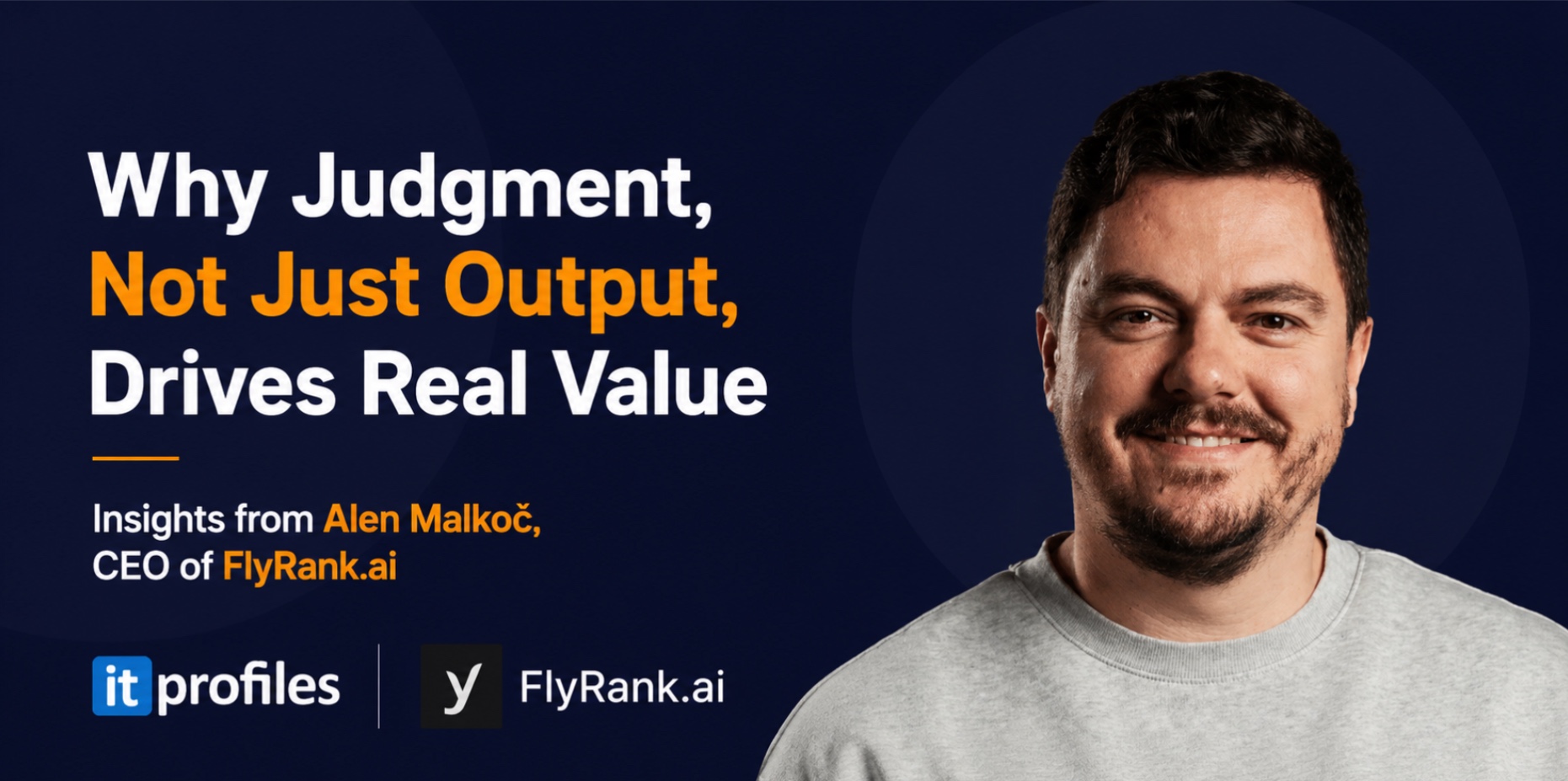
Outcomes Over Outputs: The Judgment Layer is the New Premium
In this exclusive ITProfiles interview, Alen Malkoc, the founder and CEO of FlyRank, breaks down the evolving chemistry between deep search expertise and the sudden ubiquity of AI. With over 25 years in the tech sector, Alen has seen multiple cycles of disruption, but his vision for the 10x.ai ecosystem suggests we are entering a phase where "more content" is actually the enemy of growth.
The core insight of the discussion centers on the "judgment layer" — the human intuition required to steer powerful AI agents toward meaningful business results rather than just digital noise. Alen highlights why FlyRank operates as an AI-only firm, arguing that the true premium lies in accountability and "digital taste" rather than just owning the software.
Outcomes Aren't Sold in App Stores
A $20 subscription gets you a draft, but it doesn't get you a strategy. Anyone can hammer a prompt and generate a mountain of text, but in a saturated market, volume is just a commodity. Alen Malkoc is blunt about the distinction: "Because $20 AI tools give you output. We give you outcomes. The tools are commodities. Anyone can buy them, prompt them, and get a draft."
The real value lies in the human architecture surrounding the automation. It's the seasoned intuition required to know which links are worth chasing and how to pivot when a model misses the mark. He explains that "What smart clients pay a premium for is the judgment layer on top: knowing which content actually moves rankings, which links are worth chasing, how to structure a site so AI engines cite you instead of your competitor, and when to ignore what the tool just spat out."
Under the hood, FlyRank runs the same high-level agents as the rest of the world, but the team owns the strategy and the QA from start to finish. It's a shift from being a tool-user to being a results-architect. The technology handles the heavy lifting, but the human oversight ensures the final product isn't just noise.
At the end of the day, accountability is the one thing a chatbot won't offer. Clients aren't paying for the novelty of AI; they are paying for a partner who is responsible for the growth number at the end of the quarter. No software interface is ever going to sign off on a 3X growth guarantee.
Why "AI-Only" Usually Ends in Tears
When a project crashes and burns, it's rarely the fault of the technology. Alen is quick to debunk the myth that automation is the villain, noting that his own firm is an AI-only operation. He observes that "The projects that fail and get blamed on 'AI' almost always failed because nobody laid the groundwork first."
If you aim an LLM at a website that lacks a cohesive topical strategy or a functional linking architecture, you are essentially automating chaos. The result is inevitably a high volume of content that fails to rank. It isn't a failure of the machine; it is a failure of the blueprint that was supposed to guide it. This is why many organizations are moving away from generic automation and back toward strategic digital product engineering to ensure the technical foundation is sound before the agents are even deployed.
Success requires building a robust infrastructure long before the first prompt is ever written. This involves creating precise topical authority maps and decoding what the search engine results pages (SERP) are actually rewarding in a specific niche. Without this data, the bots are effectively flying blind.
Alen's approach emphasizes that the human heavy lifting happens at the beginning. As he explains, "What we do differently is build the infrastructure before we let the agents loose: clear topical authority maps, a real understanding of reader intent, and signals on what search engines and AI answer engines are actively promoting in that niche."
Clarity is the Best Form of Empathy
When a technical crisis hits — whether it's a sudden ranking drop or a broken migration — the typical corporate instinct is to offer soft words and reassurance. Alen views this differently, arguing that emotional soothing is a poor substitute for professional competence. He notes that "'Human empathy' is the easy answer, but it's not really what keeps clients calm when things go sideways. What keeps them calm is clarity and ownership."
A client facing a digital emergency isn't looking for a shoulder to cry on; they are looking for a roadmap out of the fire. Empathy, when stripped of a concrete strategy, often feels like a stalling tactic rather than a solution. If you can't provide a path forward, your concern just sounds like "panic management."
The FlyRank philosophy centers on a rapid-response framework that prioritizes data over sentiment. The goal is to eliminate the vacuum of uncertainty that breeds client anxiety. By taking immediate ownership of the problem, the team shifts the focus from the setback to the recovery process.
Ultimately, trust is maintained through transparency and speed. Alen simplifies the client's needs down to a very specific set of requirements: "When a project hits a wall... clients don't want to be soothed. They want to know three things, fast: what happened, why it happened, and what we're doing about it by when."
The Fallacy of the "Handmade" Label
In modern tech, the "100% Human" badge is often treated like an organic sticker on a grocery store shelf, but Alen argues this comparison is fundamentally flawed. In agriculture, "organic" implies a superior product, but in software and SEO, removing technology often just leads to inefficiency. Alen suggests that "'Organic' and 'handmade' work as quality signals because the alternative (mass-produced, chemical-laden) is genuinely lower quality in measurable ways. With AI vs. human, that's not true anymore."
The reality is that a well-tuned machine, guided by the right architect, frequently outperforms a manual process across every meaningful metric. A team clinging to manual labor is often just a team that hasn't learned how to scale. Speed, consistency, and the ability to process vast datasets are no longer things a human can do better than an AI agent.
When a firm leans too heavily into the "human-only" marketing angle, it often reveals a lack of technical maturity rather than a commitment to craft. It suggests the agency is either struggling to modernize its workflow or is using the label to justify a bloated invoice. For Alen, "100% Human" isn't a sign of quality; it's a red flag for a dated operation.
The future doesn't belong to the purists on either side of the fence, but to the pragmatists who know how to blend both. Excellence comes from a specific synergy where the machine handles the heavy lifting and the person handles the high-level decisions. As Alen summarizes: "The winning position isn't '100% Human' or '100% AI.' It's human judgment + AI execution, and being honest about which is which."
Doubling Down on Digital Taste
As the barrier to content creation drops to zero, the market is being flooded with "perfectly average" output. To remain irreplaceable, Alen isn't betting on more complex algorithms or softer management styles; he is focusing on a much more subjective, human faculty. He identifies this core differentiator clearly: "The one we're doubling down on is TASTE."
Taste, in this context, is the filter that separates the signal from the noise. It is the refined ability to distinguish between a technically correct draft and a piece of content that actually captures a brand's soul. Without it, an agency is just a high-speed printing press for mediocre ideas that nobody wants to read.
This skill isn't about abstract creativity, but about the surgical precision of choice. It involves looking at a spread of automated options and identifying the one specific angle that will actually disrupt a reader's scroll. It is the human gatekeeper who ensures the brand's reputation isn't diluted by the sheer volume of "safe" AI suggestions.
For FlyRank, the goal is to develop a sharp eye for what is truly differentiated versus what is merely generated. Alen defines this modern necessity as: "The ability to look at ten AI-generated outputs and instantly know which one is going to land... which piece of content is worth shipping and which one quietly makes the brand look worse."
The Power of Being Disagreeable
Where everyone is using the same models to generate the same polite, helpful content, the result is a sea of aggressive mediocrity. To break through, Alen argues that you have to abandon the "safe" middle ground that AI naturally gravitates toward. He believes the secret to standing out is simple: "Start from a take, not a topic. Before any agent writes anything, there's a human-defined angle."
Large Language Models are designed to be helpful, harmless, and inherently agreeable, which is precisely why they struggle to produce a unique voice. True personality requires friction — the willingness to say something that might actually annoy a segment of the audience. If your content doesn't risk alienating someone, it probably isn't interesting enough to attract anyone either.
By feeding the AI a "mildly contrarian" seed, you force the output to take a side, transforming a generic blog post into a brand-defining manifesto. Alen uses his own philosophy as the primary example, pointing to stances like "'AI-only isn't the problem, bad infrastructure is.' '100% Human is a marketing tell, not a quality signal.'" These aren't just sentences; they are battle lines.
Ultimately, voice is found in the willingness to be disagreeable. While the bots handle the syntax, the human provides the "swag" — that intangible sense of confidence and perspective that separates a leader from a follower. As Alen dryly notes, while he's not sure how successful they are in the "swag" department, having a bit of it certainly helps in a world of clones.
Sensing the Shift in Real Time
In an industry defined by volatility, the biggest danger for an agency isn't the AI itself, but the human tendency to fall into a state of automated "laziness." When teams outsource 100% of the thinking to a machine, they lose the ability to detect subtle changes in the digital atmosphere. Alen points out a fundamental flaw in static models: "The one thing a bot will never understand about SEO/GEO right now (or any rapidly-evolving category): it can't feel when the ground is shifting!"
A bot operates on training data — essentially, a rear-view mirror view of the world. It can tell you what worked yesterday or six months ago, but it lacks the sensory perception to recognize a sea change as it happens. In SEO, by the time the data confirms a shift, the opportunity to pivot has often already passed.
Human intuition acts as an early warning system that technology simply cannot replicate. It's the "gut feeling" a seasoned strategist gets when search results start looking different or when user behavior begins to warp in a new direction. You can't program a bot to feel the tension in the market before the numbers catch up.
Being an effective leader in this space means staying hyper-aware of these tremors. While the agents are busy processing the known variables, the humans must remain focused on the unknown ones. Success isn't about following the old map faster; it's about knowing when the map has become obsolete.
The Dangerous Duality of Gut Feeling
In the boardroom, "founder's instinct" is often treated as a mystical superpower, but Alen offers a more clinical dissection of the term. He argues that most intuition is either a shortcut for deep experience or a mask for personal ego. He warns that "What people call 'gut feeling' is almost always one of two things: compressed pattern recognition from years of being in the work, OR bias dressed up as wisdom."
While the former is a legitimate competitive advantage, the latter is a silent killer of businesses. Relying on "bias dressed up as wisdom" has led to more corporate post-mortems than any disruptive technology. Interestingly, Alen acknowledges that AI is rapidly closing the gap on pattern recognition, as it can synthesize thousands of historical cases faster than any human brain.
Where the machine truly hits a ceiling is in the realm of high-stakes, cultural risk-taking. AI is built on the logic of the spreadsheet, which makes it inherently incapable of recommending a move that defies conventional data. It can calculate the "safe" path, but it can't tell you when to take the path that looks objectively irrational on paper.
True intuition is found in the ability to place a "weird, uncomfortable" bet that only makes sense if you have a pulse on the zeitgeist. It is the human element that allows a founder to navigate the nuances of a specific niche where the data is either silent or misleading. As Alen puts it, "Knowing which weird, uncomfortable, slightly-off-brand bet is worth taking... only makes sense if you deeply understand the culture you're operating in."
The New Luxury: Accountability and Judgment
The surge of "cheap" AI-generated content hasn't actually introduced a new problem; it has simply made an old one more visible. For years, agencies have churned out generic, undifferentiated work using low-cost labor, but AI has now automated that mediocrity at scale. Alen is quick to point out that the tool isn't the issue, noting, "AI just made the bad version cheaper and more visible."
When a service is aimed at "nothing specific," it loses its value immediately. Clients are starting to see through the smoke and mirrors of high-volume, low-intent content. They realize that a mountain of words — whether written by a bot or a room full of budget writers — is still just a commodity if it doesn't solve a business problem.
In this environment, a human-led strategy is becoming a high-end service because it offers something the "cheap" alternatives cannot: a face and a guarantee. As the market becomes flooded with automated noise, the premium shifts away from the production itself and toward the person standing behind the results.
True luxury in the agency world now comes down to two specific human traits. In an era of infinite, unaccountable output, the ability to make a call and own the consequence is the ultimate differentiator. As Alen concludes, "What clients are actually willing to pay a premium for is judgment and accountability. And those happen to still be human, for now."
The Myth of the "Back to Humans" Movement
The romanticized idea of a mass exodus from automation back to manual labor is a popular talking point, but it rarely aligns with how people actually spend their money. While many voice frustrations with digital interfaces in surveys, their wallets usually tell a different story. Alen observes this contradiction clearly: "People say they're tired of bots in surveys, and then they pick the faster, cheaper, 24/7 option every single time in their actual behavior."
Efficiency is a difficult commodity to quit. Once a consumer or a business experiences the speed of a 24/7 automated response, waiting three days for a human email feels like a regression. The "bot-first" world isn't a temporary trend; it is the new baseline for the mechanical and repetitive aspects of our professional lives.
However, this doesn't mean the human element is becoming obsolete; it is simply being recontextualized. We aren't headed toward a "bot-first dystopia," but rather a more efficient division of labor. The future isn't about choosing one over the other, but about identifying which tasks actually benefit from a human pulse and which are better served by a script.
In this evolving landscape, the value of a person's time is actually being driven higher. As the mundane work is offloaded to machines, the remaining tasks require a level of nuance that commands a much higher price point. Alen summarizes this "quiet sorting" perfectly: "Automation handles the boring 80% and humans get repriced upward for the 20% that genuinely needs them."
Ready to turn organic into a growth channel?
Book a free 30-minute strategy call.

Written by
Alen Malkoc
CEO, FlyRank